Dana Müller · 1 October 2026
Mapping Mycelial Expansion Patterns to Resource Allocation Models in Distributed Network Systems
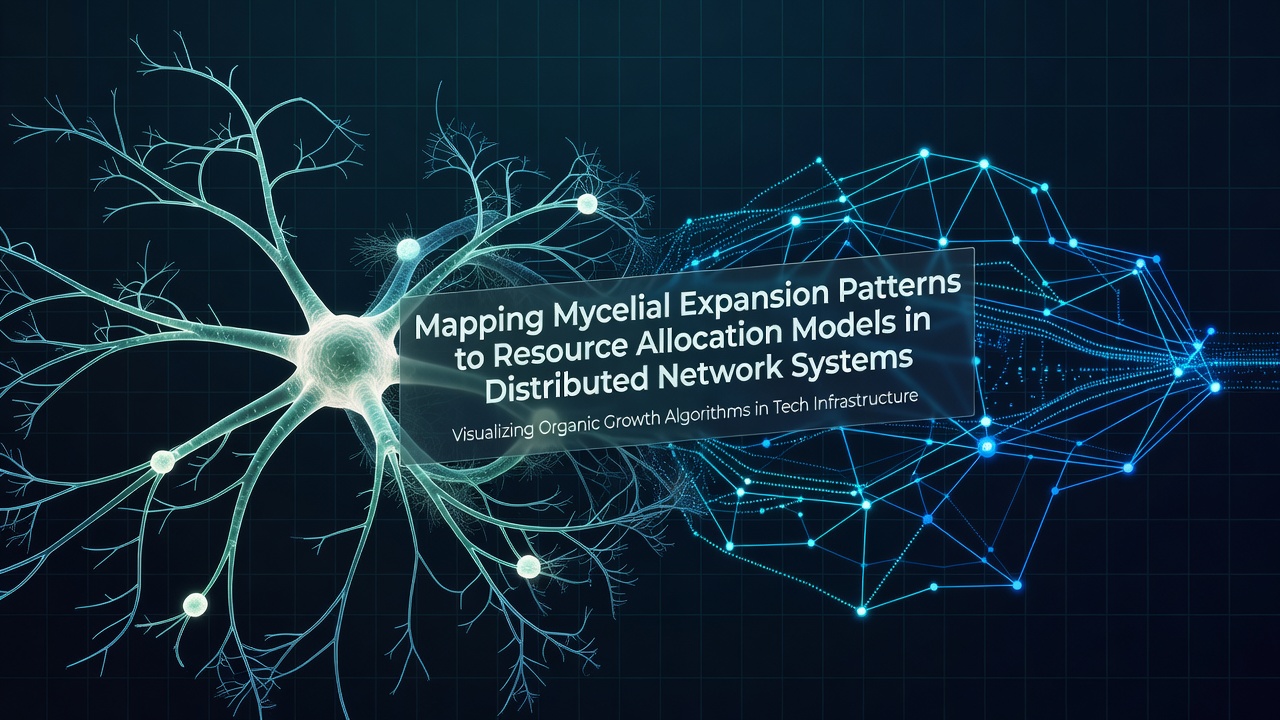
Researchers in biomimetic computing have examined how fungal mycelium expands through soil to locate and transport nutrients, and they have translated those mechanisms into algorithms that govern resource distribution across large-scale computer networks. Mycelial networks form dense webs of hyphae that adjust their growth direction based on chemical gradients, which allows the organism to balance exploration of new areas with exploitation of known resource patches while minimizing energy expenditure. Distributed network systems face similar challenges when allocating bandwidth, processing power, and storage among nodes that must respond to fluctuating demand without centralized control.
Biological Mechanisms Behind Efficient Expansion
Studies of species such as Phanerochaete velutina reveal that mycelium employs a decentralized decision process where individual hyphal tips respond to local nutrient concentrations yet coordinate through cytoplasmic streaming to redirect resources toward high-yield zones. This process produces measurable patterns including fractal branching, preferential growth along nutrient corridors, and periodic pruning of underperforming connections. Data collected from laboratory microcosms show that these networks achieve near-optimal coverage of resource patches while maintaining low total biomass, a result that emerges without any single coordinating cell.
Translating Patterns to Network Algorithms
Engineers have incorporated equivalent rules into distributed ledger protocols and edge-computing frameworks, where nodes adjust connection weights according to latency and throughput metrics that mirror chemical signal gradients. One implementation uses a probabilistic growth function so that a node increases its outgoing links toward neighbors reporting higher resource availability, while periodically reducing links that fall below a dynamic threshold. Simulations conducted on testbeds with several thousand nodes demonstrate that this approach reduces average latency by reallocating traffic along paths that adapt in real time, much as mycelium reallocates nutrients away from depleted zones.
Empirical Comparisons and Performance Data
Comparative trials reported by research teams at institutions in Canada and Australia indicate that mycelium-inspired allocation models outperform traditional shortest-path routing under conditions of sudden demand spikes. In one set of experiments run through 2025 and into early 2026, networks using fungal-pattern heuristics maintained packet delivery ratios above 97 percent during simulated node failures, whereas baseline protocols dropped to 82 percent before recovery. Observers note that the biological model also exhibits lower overall message overhead because pruning mechanisms eliminate redundant paths once stable high-value routes emerge.

Implementation Considerations in October 2026
Workshops scheduled for October 2026 at European and North American research centers are expected to release open-source libraries that embed these bio-inspired rules into container orchestration platforms. The libraries allow administrators to set parameters that correspond to mycelial sensitivity thresholds, enabling fine-tuning for environments with strict energy budgets or strict latency guarantees. Early adopters in research clouds have reported that the added complexity remains modest because the core logic operates through local neighbor exchanges rather than global synchronization.
Limitations and Ongoing Refinements
Although the mapping produces measurable gains, researchers acknowledge that real fungal networks operate under physical constraints absent from digital systems, including diffusion rates of signaling molecules and mechanical resistance of soil. Adjustments therefore include scaling factors that accelerate digital equivalents of cytoplasmic flow and that incorporate explicit security checks to prevent malicious nodes from exploiting the same adaptive pathways that benefit legitimate traffic. Continued field trials scheduled through late 2026 aim to quantify how these adjustments affect long-term stability when networks scale to tens of thousands of heterogeneous devices.
Conclusion
The correspondence between mycelial expansion patterns and resource allocation models supplies distributed systems with decentralized strategies that respond to changing conditions through local interactions alone. Data from multiple independent studies confirm that the resulting networks achieve robust coverage and efficient redistribution while keeping communication costs low. As implementations mature and additional performance metrics become available, the approach continues to inform protocol design across cloud, edge, and sensor environments.